Climate and Migration
I’d like to start this edition of the newsletter with a thought experiment. Imagine if you will that you are just married and you are on your honeymoon to the wonderful island of Tuvalu. You spend a few glorious weeks there living your best life before coming home and being subjected to the current realities of life. After some time you have children and as they grow up hearing about the wonderful time you had on Tuvalu because you just won’t stop bringing it up at family events. They decide that they want to visit this island and see for themselves what all the fuss is about. So they do research and they start seeing some worrying information. In the 20 odd years since you had your magical honeymoon on the island things have taken a turn for the worse. Due to sea level rise caused by climate change the island does not have the capacity to take on tourists due to the fact that sea water has contaminated their arable land, groundwater and washed away any excess land for housing. This is pushing the resources of the island to the extreme. In fact many Tuvaluans have immigrated to Australia as they cannot survive on their own island. In the space of one generation the ability to see a part of our planet has been taken away.
This is a future that is looking ever more likely if we don’t take action against climate change. It might seem extreme and an exaggeration but I think when framed in this way the timelines become more understandable. If I just told you that by 2100, 95% of the island would be underwater during high tide that might not have the same effect on you. Now this is actually not about the precarious state of the island nation but about climate and migration...as the title says. Tuvaluans are not in fact the first migrants effected by anthropogenic climate change and they certainly wont be the last. If you would allow me to deviate slightly from the main topic. The book Late Victorian Holocausts by Mike Davis discusses Famines caused by extreme El Nino events in the late 19th century that were made worse by imperialist and capitalist policies which lead to the deaths of some 30 – 60 million people globally which also displaced thousands of people. People were forced to migrate to regions where they could find work and food which lead to early forms of disaster capitalism where the ruling powers enslaved desperate people and put them to work with minimal rations. At time of writing I am 50% through the book but the opening chapters give you a solid idea of how weather and capitalism can drastically change peoples lives and displace large portions of a population. While not an example of anthropogenic climate change it is an example of what happens when extreme weather hits.
More recent climate change displacements can be seen in the South Sudan where flooding between 2020 and 2022 displaced 1.5 million. Then in 2024 more people were displaced by flooding which combined with regional conflict has stopped many people from returning to their land and stripped them of their livelihood. These floods are connected to the Indian Ocean Dipole(similar to El Nino) that brings heavy rains to the region and could get more intense as the climate warms. Another example is that of Bangladesh where an increase in cyclones, sea level rise and flooding is forcing more people to migrate in land. Bangladesh is one of the most vulnerable countries to climate change, but on a more positive note also leading the charge in climate adaptation. However this doesn’t stop the effects of climate change displacing people. In fact the World Bank estimates that by 2050 some 19 million people will be internally displaced due to climate change. Notice here how I have not spoken about mass migration to other countries. See my previous post about that. In fact most migration takes place internally or to a neighbouring state. According to statista there will be an estimated 170 million displaced peoples world wide by 2050 due to climate change. Take some time to look at this nice colourful graph before we move on.
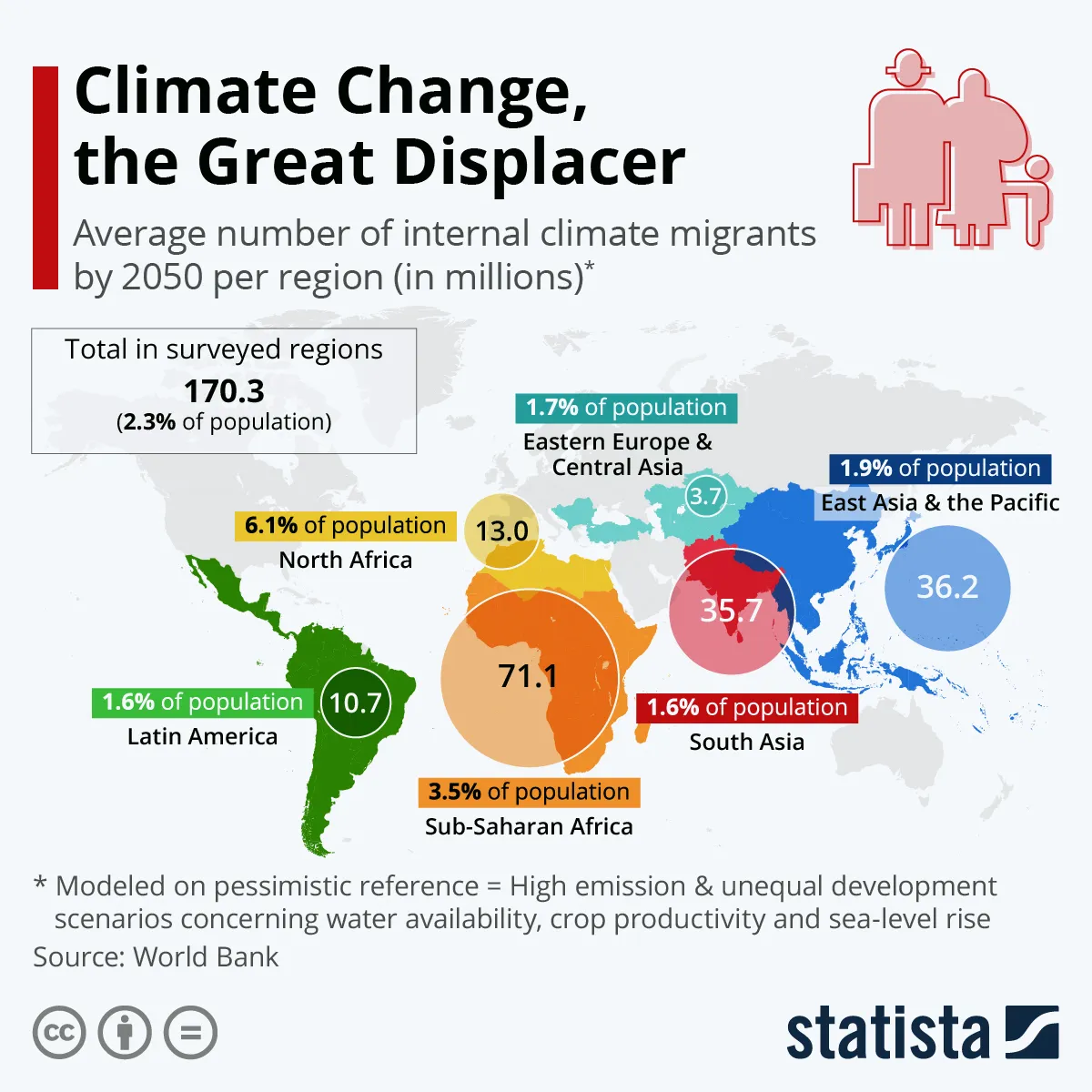
I hope you enjoyed that graph even though it is showing some terrible statistics. I have provided you with some seriously big numbers that make sense but are also so big that the human mind cant really comprehend them. Seriously 170 million is a monstrous number. I struggle to really discuss this topic or think about it as a whole because things start to break apart in my head when I try to fit the pieces together to form a whole picture. These issues aren’t going away unless we start doing something about it and changing the way we view them. At time of writing there are race riots happening in Belfast. The narrative around this is that people want migrants out of their city because they are bad and are destroying the culture of the community. This is the narrative that mass migration harms society but, this is simply not true. Migration has been happening for as long as humans have been around and will continue to happen as long as we are still around. A counter narrative to this is that governments can manage migration and indeed benefit from it by adding people to the labour force and driving up economic growth. I find the problem here is that this is from the point of view of a capitalist and changes the person in question into a number that’s only purpose is to make the big number go up. I think we need to view migrants/immigrants as people first. How can we as a collective solve the biggest issue of our time if we cant acknowledge the humanity of another person? Now I realise that the current unrest stems from a violent attack on another person but that is most likely the failing of the state as it often doesn’t provide adequate social care to migrants because there is no profit in it. There is also the ability to scapegoat them for their own benefits down the line and allow for them to push whatever policy they need to increase control or profits.
I want to take you back to the island of Tuvalu. A former resident named Alolita Tekapu managed to move to Australia due to a migrant deal that was made between Tuvalu and Australia. She won a lottery and packed her family up to move thousands of kilometers away to a new place to start her life over. This is not easy in the slightest. This is a massive change in lifestyle and culture but it allows her to work and send money home that could be used for climate adaptation and mitigation projects. It is awfully nice of Australia to do this but it would be better if Alolita didn’t have to leave her home. Australia could start working towards a more sustainable economy and decouple from their mining industry. The idea that climate migrants should fund the climate adaptation projects is absurd.
That was a bit of a tonal shift I know. It is not my intention to make this come across as some sort of conspiracy but more to show how the system functions in reality. All that being said I like to simplify this entire topic for myself. Start to see migrants and immigrants as people and approach these issues with compassion and nuance because its one helluva complex issue. I think once we can do this we can then start to approach climate action with more vigour and positive rage aimed at those who are causing the needless suffering of millions of people.
(RE)Sources
https://www.unicef.org.au/stories/tuvalu-climate-change-photo-essay
https://www.statista.com/chart/26117/average-number-of-internal-climate-migrants-by-2050-per-region/
https://earth.org/climate-migration-a-multidimensional-challenge-requiring-global-action/